You Won’t Believe What I Found in Kyoto’s Hidden Cultural Spots
Kyoto isn’t just temples and tea—there’s a deeper side waiting to be explored. I wandered beyond the postcard sights and stumbled upon quiet alleys housing centuries-old craft studios, intimate performance spaces, and family-run cultural gems most tourists miss. Each venue told a story, not for cameras, but for those who take the time to listen. This is Kyoto as a living culture, not a museum piece. If you're looking for authenticity, this journey is your doorway.
Stepping Off the Beaten Path
Kyoto’s most iconic landmarks—Kinkaku-ji with its golden shimmer, Fushimi Inari’s endless red torii gates—draw millions each year, and for good reason. These sites are masterpieces of design and devotion, symbols of Japan’s enduring spiritual heritage. Yet, the soul of Kyoto often whispers in quieter places, far from the camera flashes and guided tour groups. Beyond the well-trodden paths lie neighborhoods like Kamigyo and Nakagyo, where life unfolds in the rhythm of tradition, not tourism. Here, tucked behind unassuming wooden facades, are ateliers where artisans practice crafts passed down for generations. These are not recreated for visitors; they are lived, daily.
Walking through these districts feels like stepping into a different era, one where time moves with intention. The narrow lanes are lined with machiya townhouses, their latticed windows and dark wood frames hinting at centuries of quiet resilience. Many of these homes still function as workshops, where the scent of sawn wood, wet clay, or simmering ink lingers in the air. In Kamigyo, a district once home to court nobles and skilled artisans, you’ll find small studios specializing in Kyoto’s famed yuzen dyeing, where intricate patterns are painted by hand onto silk kimonos. The process is slow, meticulous, and largely invisible to the casual observer—yet it remains vital to the city’s cultural fabric.
What makes these spaces so powerful is not their size or grandeur, but their continuity. Families have maintained these practices for hundreds of years, often in the same location, passing down tools, techniques, and philosophies from parent to child. A single workshop might have served three or four generations, each adding subtle refinements while honoring the core traditions. This is not preservation for display—it is preservation through practice. Travelers who seek these places discover a Kyoto that breathes, one where culture is not performed but lived. The reward is not a photo for social media, but a moment of connection with something enduring.
The Soul of Kyoto in Craft Studios
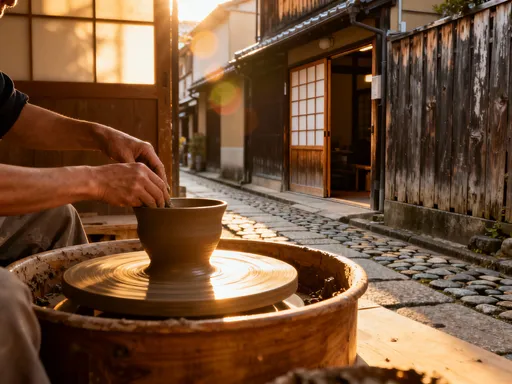
Within Kyoto’s hidden alleys, craftsmanship is not a hobby—it is a vocation, a way of life. In modest workshops no larger than a living room, artisans dedicate their lives to perfecting a single skill. I stood in silence as a third-generation potter shaped a bowl on a kick wheel, his foot pumping rhythmically while his hands guided the spinning clay into a form both elegant and functional. He explained that in Kyoto’s ceramic tradition, beauty is never separate from utility. A tea bowl must feel right in the hand, warm to the touch, its curve designed to cradle heat and invite contemplation.
This philosophy, known as *takumi*, embodies the Japanese pursuit of mastery. It is not about speed or output, but about depth, patience, and attention to detail. In another studio, a papermaker demonstrated the art of washi, pulling delicate sheets from a vat of mulberry fiber. Each sheet was laid out to dry in the sun, its texture slightly uneven, bearing the mark of human hands. Unlike mass-produced paper, washi is strong, soft, and alive with character. It is used in everything from restoration work on ancient scrolls to modern calligraphy, bridging past and present.
Visitors are sometimes welcomed into these spaces through short workshops, where they can try their hand at a craft under the guidance of a master. These experiences are not about creating a perfect souvenir; they are about understanding the effort behind one. I attempted to paint a simple design on a porcelain plate using traditional mineral pigments. My brushstrokes were clumsy, my lines uneven—but in that struggle, I gained a new appreciation for the precision of the artisans. These moments of participation deepen the traveler’s connection to the culture, transforming observation into empathy.
Such studios are not tourist traps. They are working spaces, often funded by commissions, private sales, or cultural grants. Many struggle to survive in a modern economy that favors speed and scale over slowness and soul. Yet, they endure because the artisans believe in their work as more than a job—it is a responsibility to history, to community, to beauty. When travelers choose to visit and support these studios, they contribute to a legacy that might otherwise fade.
Intimate Theaters and Living Performances
Kyoto’s performing arts are not confined to grand theaters with red velvet seats and printed programs. Some of the most powerful experiences happen in small, unmarked venues where tradition unfolds in near silence. I attended a Noh performance in a wooden hall no larger than a community center, the stage lit by soft, warm lamps that made the actors’ carved masks glow like ancient spirits. The music was sparse—drums, flute, and the haunting chant of the performers—yet the emotional weight was immense. Every gesture, every pause, carried centuries of meaning.
Noh theater, with roots stretching back to the 14th century, is one of the oldest continuous theatrical traditions in the world. Its stories often revolve around ghosts, lost love, and spiritual transformation, told through highly stylized movement and poetic language. For non-Japanese speakers, the plot may be difficult to follow—but the emotion transcends words. I watched an elderly woman in the front row wipe tears from her eyes during a scene about a mother searching for her son’s spirit. The performance was not entertainment; it was ritual.
Similarly, Kyoto is home to small Bunraku puppet theaters, where life-sized puppets are manipulated by three visible handlers in black robes. The puppeteers move with such precision that the puppet seems alive, its wooden face expressing sorrow, joy, or rage. The narration, delivered by a single chanter with a voice that shifts between characters, is accompanied by the plucked strings of the shamisen. These performances are not tailored for tourists; they are part of a living tradition sustained by dedicated troupes and loyal local audiences.
What makes these experiences so profound is their intimacy. Seating is close, often on tatami mats, allowing viewers to see the sweat on a performer’s brow or the flicker of a candle behind the stage. There are no microphones, no spotlights—just the raw presence of art in motion. Travelers who seek out these spaces are not passive spectators; they become witnesses to a cultural heartbeat. Respecting the silence, arriving on time, and dressing modestly are small ways to honor the gravity of the moment.
Tea Houses Beyond the Ceremony
The Japanese tea ceremony is well known, often portrayed as a formal, almost ritualistic performance. And while there is beauty in that precision, Kyoto also offers quieter, more personal tea experiences—ones that focus not on perfection, but on presence. In a hidden garden in Arashiyama, I was invited into a thatched tea house by a tea master who spoke softly about the four principles of *chado*: harmony, respect, purity, and tranquility. These, she said, are not just rules for tea—they are guides for living.
The space was simple: a low wooden table, a bamboo whisk, a bowl of bright green matcha. Outside, a moss-covered stone basin trickled with water, its sound blending with the rustle of leaves. As she prepared the tea, her movements were deliberate, unhurried. She did not speak much, and neither did I. There was no need. The act itself was the conversation. When she handed me the bowl, I turned it slightly—so the front faced away, a gesture of humility—and sipped slowly. The tea was bitter, earthy, warm. It was not about flavor alone, but about the moment.
This was not a staged demonstration for tourists. It was a daily practice, a way for the tea master to center herself and share that stillness with others. She had studied for decades, not to perform, but to understand. Her family had been tea practitioners for generations, and the house had been in their care for over a century. The tea room, with its worn tatami and hand-plastered walls, bore the marks of time and use—each imperfection a testament to its authenticity.
Such spaces remind us that culture is not always loud or dramatic. Sometimes, it lives in the quiet act of preparing a bowl of tea, in the shared silence between strangers, in the decision to slow down. For travelers, these moments offer a rare kind of rest—not from physical fatigue, but from the constant noise of modern life. In Kyoto’s hidden tea houses, one does not merely drink tea; one learns to be still.
Machiya: Traditional Townhouses with Stories
Kyoto’s machiya are more than picturesque buildings—they are vessels of memory and adaptation. These narrow wooden townhouses, with their latticed fronts and tiled roofs, once housed merchants, artisans, and scholars. Built to withstand earthquakes and seasons, they were designed for both privacy and connection, with inner courtyards that brought light and air into the home. Today, many have been carefully restored, not as museums, but as living spaces that blend tradition with modern comfort.
I had the chance to stay in a restored machiya in the Nishijin district, known for its textile weaving. The owners, a couple in their fifties, had converted part of the home into a cultural salon, hosting weekly gatherings for calligraphy, koto music, and seasonal tea tastings. As I walked through the house, I noticed the sliding doors—*fusuma*—their edges worn smooth by decades of hands. The floorboards creaked underfoot, not as flaws, but as signs of life. Each room had a purpose: a meditation corner, a reading nook, a small kitchen where traditional meals were still prepared.
What struck me most was how the space felt both ancient and alive. Modern amenities were present—soft lighting, comfortable bedding, a small bathroom—but they were integrated with care, never disrupting the home’s character. Sleeping in a machiya is different from staying in a hotel. You are not just a guest; you are a temporary caretaker of history. The quiet at night, the morning light filtering through paper screens, the scent of wood and tatami—it all invites reflection.
Some machiya have been turned into small guesthouses, offering travelers a chance to experience Kyoto from within its cultural framework. Unlike Western-style hotels, these stays emphasize simplicity, mindfulness, and connection. Guests are asked to remove their shoes, to speak softly, to appreciate the details. In doing so, they participate in a way of life that values quiet over spectacle, depth over speed. The machiya, in its resilience and reinvention, stands as a metaphor for Kyoto itself—rooted in tradition, yet open to the future.
Finding Guidance Without a Map
Navigating Kyoto’s hidden cultural spots requires more than a smartphone or a guidebook. It demands curiosity, patience, and a willingness to get lost. Many of these places have no signs in English, no websites, no reservations. They are found not through algorithms, but through conversation. I learned this when a shopkeeper near Nishiki Market noticed me photographing a narrow alley and quietly asked if I liked traditional crafts. When I said yes, he smiled and pointed down a side street, murmuring the name of a private ukiyo-e printing studio.
I followed his directions and found a small wooden door with no label. I hesitated, then knocked. After a moment, an elderly man opened the door, studying me with calm eyes. I bowed slightly and explained, in broken Japanese, that I had been recommended. He nodded and invited me in. For the next hour, he demonstrated the process of woodblock printing, carving delicate lines into cherry wood and pressing inked blocks onto handmade paper. He did not charge me. He simply shared his craft.
This kind of discovery is common in Kyoto—if you are open to it. Locals often recognize genuine interest and are willing to guide those who approach with humility. A simple “sumimasen” (excuse me) followed by a respectful question can open doors that no app can unlock. The lack of English menus, the absence of ticket booths, the unmarked entrances—these are not barriers, but invitations to slow down, to observe, to connect.
Wandering without urgency allows serendipity to guide you. I once followed the sound of a shamisen through a back alley and found a small music school where students were practicing traditional songs. I stood quietly at the edge of the room, and the teacher gestured for me to sit. I did not understand the lyrics, but the music spoke clearly. These unplanned moments often become the most meaningful parts of a journey. They remind us that travel is not about checking off destinations, but about being present for the unexpected.
Traveling with Respect and Awareness
Access to Kyoto’s hidden cultural spaces is a privilege, not a right. These are not attractions designed for mass tourism; they are homes, workshops, and sacred spaces where lives are lived and traditions are upheld. Photography is often restricted, not out of secrecy, but out of respect for the craft and the people. In a Noh rehearsal, I saw a visitor raise their phone—only to be gently stopped by an usher. The performance was not for recording; it was for experiencing.
Simple gestures carry great meaning. Removing your shoes before entering a home or studio, bowing slightly when greeted, speaking in a soft voice—these are not formalities, but signs of respect. They signal that you are not there to consume, but to honor. In a city where tradition is deeply woven into daily life, these acts of mindfulness help preserve the authenticity of the experience for everyone.
Supporting these spaces responsibly also means choosing experiences that prioritize the artisans and performers, not the profits of large tour operators. Booking directly with a studio, purchasing handmade goods at fair prices, or donating to cultural preservation efforts—these actions sustain the very traditions travelers come to see. It is easy to romanticize Kyoto’s culture from afar, but true appreciation comes from understanding the effort behind it and acting with care.
When we visit with respect, we become part of the story, not just observers of it. We help ensure that these quiet, powerful spaces continue to exist—not as relics, but as living parts of Kyoto’s present and future. The city does not need more crowds; it needs more mindful travelers, those who come not to take, but to listen.
Conclusion
Kyoto’s true magic isn’t in checklists—it’s in moments of quiet connection. By stepping into real cultural spaces, travelers don’t just see tradition; they feel it. They hear the scrape of a chisel on wood, the whisper of a tea whisk, the hush of a Noh stage before the first note. These are not performances for an audience; they are practices kept alive by those who believe in their value.
This kind of exploration transforms sightseeing into meaning. It asks us to slow down, to be present, to engage with culture on its own terms. The city invites us not to consume, but to listen, learn, and leave with deeper understanding. In a world that often values speed and spectacle, Kyoto offers a different path—one of stillness, craftsmanship, and continuity.
Let your journey be guided not by crowds, but by curiosity. Step off the main streets, follow quiet alleys, and allow yourself to be surprised. The hidden cultural spots of Kyoto are not hiding from you—they are waiting for you to notice them. And when you do, you may find, as I did, that the most unforgettable moments are the ones no one told you to see.